

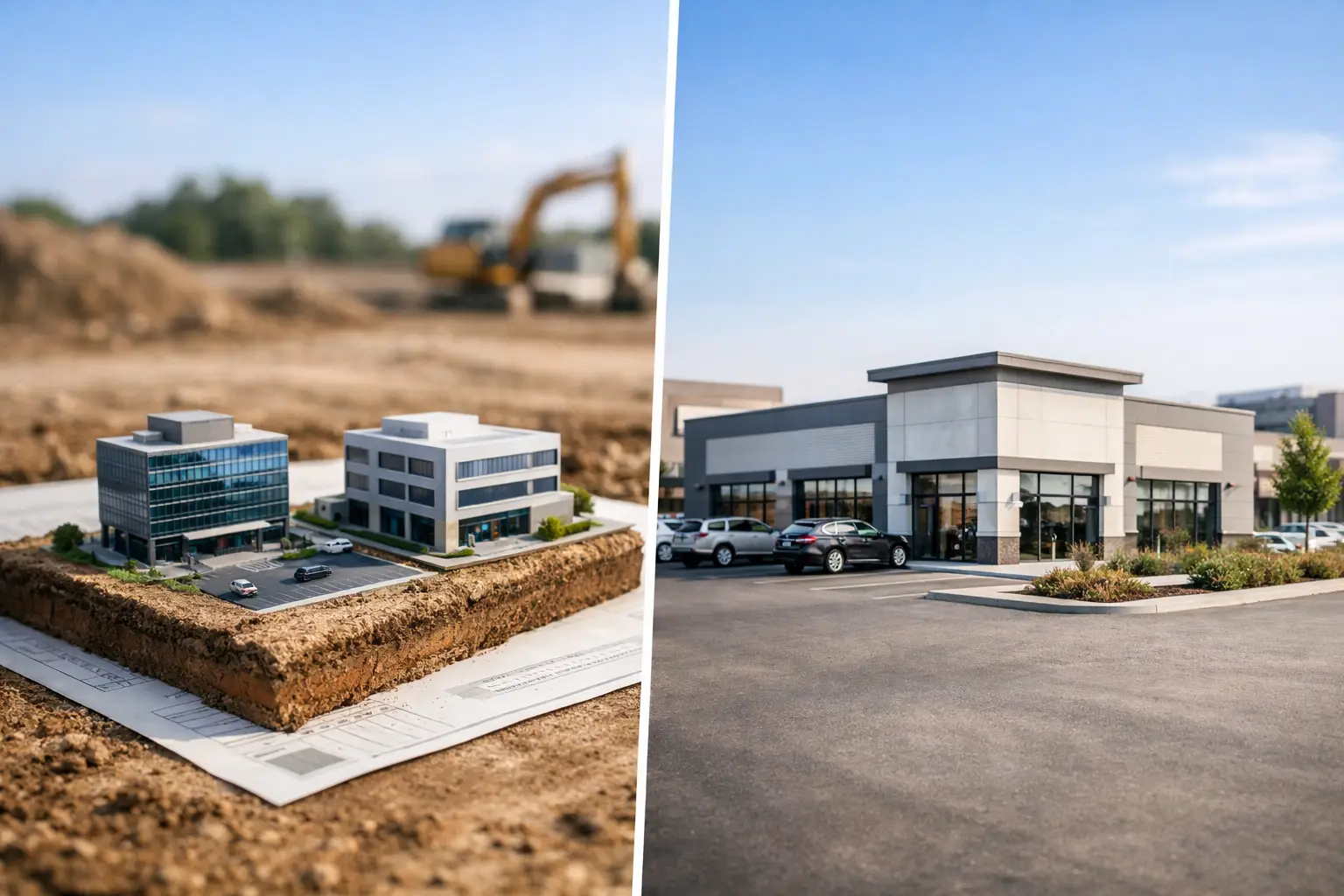
A well-located commercial site can determine operating efficiency, customer access, expansion capacity, and eventual asset value for decades. The ground lease versus purchase decision is therefore not simply a real estate preference. It is a capital-allocation decision that should be measured against the company’s operating strategy, cost of capital, balance sheet, and long-term plans for the location.
For an owner-user, developer, or investor, either structure can be the stronger choice. The right answer depends on what the property must accomplish and who should bear the risks associated with land ownership, construction, financing, and future disposition.
Ground Lease Versus Purchase: The Core Difference
A ground lease separates ownership of the land from ownership of the improvements. The landowner retains title to the site and leases it to a tenant, often for a long term of 20 to 99 years. The tenant may construct and own the building during the lease term, subject to the lease provisions. At expiration, the improvements may revert to the landowner, be purchased by the landowner, or be removed, depending on the negotiated agreement.
A purchase places both the land and improvements under the buyer’s control. The buyer can build, occupy, lease, refinance, renovate, or sell the property, subject to zoning, financing documents, easements, and other normal restrictions.
That distinction affects much more than monthly occupancy cost. A ground lease typically requires less capital at the outset because the tenant is not buying the land. A purchase requires more initial equity and closing costs, but it creates a tangible asset that may appreciate and provide greater flexibility over time.
When a Ground Lease Can Improve Capital Efficiency
Ground leases are often useful when a business needs a premium location but would rather direct its capital toward operations, equipment, inventory, hiring, or expansion. A retailer, medical provider, bank, restaurant operator, or corporate user may value site control without tying up substantial funds in land.
For a developer, leased land can also make a project feasible where land values are high or an owner will not sell a strategically important parcel. In mature commercial corridors, the most effective site may be controlled by a family, institution, or investor with a long-held ownership position. A ground lease can provide access to that location when a fee-simple acquisition is not available.
The key advantage is capital preservation. Instead of making a large land investment, the tenant commits to periodic rent and may apply capital to the building or the business itself. If those retained funds generate a higher return in the operating business than the expected return from land ownership, leasing may be financially sound.
A ground lease can also offer predictability if the rent schedule is carefully negotiated. Fixed increases, defined renewal options, and clear operating-cost responsibilities can help a tenant forecast occupancy costs over a long planning horizon.
However, lower initial capital does not automatically mean lower total cost. Ground rent continues throughout the term, and escalation clauses can materially affect the economics. Percentage increases, Consumer Price Index adjustments, market-value resets, and periodic reappraisals should be modeled before a lease is signed. A lease that appears affordable in year one may be restrictive in year 20.
The Control and Value of Owning the Site
Purchasing commercial real estate gives an owner-user direct control over a strategic asset. The buyer can improve the property without seeking a landlord’s approval beyond applicable regulatory or lender requirements. That flexibility matters when a company expects to expand, add parking, modify access, develop excess land, or reposition the building for a future use.
Ownership also allows the business to benefit from appreciation in land value. This can be particularly meaningful for well-positioned industrial sites, medical corridors, financial locations, and redevelopment parcels. While appreciation is never guaranteed, a carefully selected property can build equity while supporting business operations.
A purchased site may also provide stronger exit options. The owner can sell the property, lease it to another user, pursue a sale-leaseback, subdivide excess acreage, or redevelop the asset. These options have value even if they are not part of the initial plan. They give management more ways to respond to changing market conditions.
The trade-off is concentration of capital and risk. A buyer bears market fluctuations, maintenance obligations, property taxes, insurance costs, and the potential for functional obsolescence. The capital committed to the property is not available for the core business, and a poorly timed or poorly located acquisition can limit future flexibility.
For investors, ownership also introduces the full responsibility of asset management. Leasing, maintenance, tenant retention, capital improvements, debt service, and disposition timing must be managed as part of the investment strategy. Those obligations can create value, but they require disciplined oversight.
Lease Terms Can Matter More Than the Rent
A ground lease should never be evaluated solely by its starting rent. The lease document governs the value and financeability of the tenant’s interest. A low rent does not offset unfavorable provisions related to term length, renewal rights, building ownership, lender protections, assignment, or end-of-term treatment.
The remaining lease term must support the anticipated useful life of the improvements and the financing term. A developer who spends significant capital on a building needs enough leasehold duration to recover that investment and preserve value for a future buyer. Lenders commonly require a lease term that extends well beyond the loan maturity, along with notice and cure rights if the tenant defaults.
Assignment and subleasing provisions deserve close attention. A corporate tenant may need the ability to assign the lease during a merger, sell the business, bring in a replacement user, or sublease unused space. Restrictions in these areas can reduce operational flexibility and impair resale value.
End-of-term provisions are equally significant. If the improvements revert to the landowner at expiration without compensation, the tenant must account for that declining leasehold value over time. The closer the lease moves toward expiration, the more difficult it can become to finance, sell, or justify major capital improvements.
Ground rent resets are another common pressure point. A lease that resets to then-current market rent can expose the tenant to a substantial future expense, particularly if surrounding development raises land values. Defined caps, objective appraisal procedures, and negotiated notice periods can reduce uncertainty.
Financing, Taxes, and Accounting Require Early Review
Financing a purchased property is generally more straightforward because the lender receives a mortgage on the fee-simple interest in the land and building. The borrower’s equity, debt service, property income, and collateral value can be evaluated through familiar underwriting standards.
Leasehold financing can be more complex. The lender will examine the ground lease as closely as the building itself. It may require the landlord to recognize lender rights, provide notice of tenant default, allow time to cure defaults, and permit the lender to take over the leasehold interest if necessary. Without these protections, financing options may be limited or more expensive.
Tax treatment should be reviewed with the company’s tax advisers. Ownership may provide depreciation opportunities for improvements and potential tax benefits associated with interest expense, while land itself is generally not depreciable. Ground-rent payments may be treated differently than ownership costs depending on the structure and applicable tax rules.
Accounting treatment also affects the analysis. Long-term leases can create right-of-use assets and lease liabilities on a company’s balance sheet. Management should understand how that treatment may influence loan covenants, financial reporting, and internal return thresholds. The answer is not always to avoid a lease, but to evaluate its full financial impact before committing.
A Decision Framework for Commercial Users and Investors
The most useful analysis begins with the property’s role in the larger business plan. If the site is mission-critical, difficult to replace, and likely to gain strategic value over time, ownership may justify the additional capital. If the location is essential but capital is better deployed into operations or growth, a ground lease may produce a better return.
The expected holding period matters. A company with a short or uncertain occupancy horizon may not want to acquire a specialized site that could be difficult to sell. Conversely, a business with long-term confidence in a location may find that recurring ground rent becomes less attractive than building equity through ownership.
The property itself should also be tested. Access, visibility, traffic patterns, utilities, zoning, drainage, environmental conditions, expansion potential, and surrounding development all affect the decision. In Mississippi, a site’s drainage, infrastructure capacity, and market depth can materially influence both development cost and future resale potential.
A disciplined model should compare the present value of ground-rent obligations with the equity requirement, debt service, taxes, operating costs, projected appreciation, and exit value associated with a purchase. It should also test less favorable conditions, including higher interest rates, slower business growth, delayed construction, and lower-than-expected resale value. The preferred structure should still make sense when assumptions are pressured.
Put the Real Estate Structure to Work
There is no universal winner in a ground lease versus purchase analysis. A ground lease can preserve capital and secure a location that cannot be acquired. A purchase can create control, equity, and a broader range of future options. Each structure becomes valuable when it supports the organization’s financial objectives rather than competing with them.
Before committing to either path, evaluate the site, the lease or purchase terms, the financing, and the planned exit as one connected decision. Commercial real estate performs best when the structure protects current operations while leaving room for the next business opportunity.